

- New
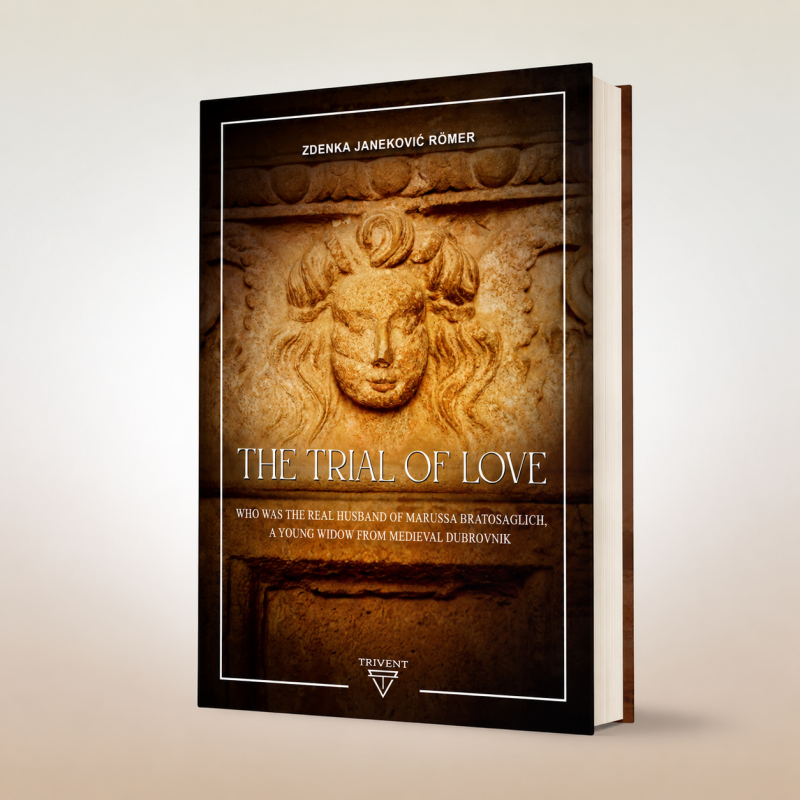


Publication date: September, 2026
Pages: 360
ISBN 978-615-7058-05-7 Paperback, €29.99
eISBN 978-615-7058-06-4 eBook, €29.99
Printed copies available in November 2026. To pre-order, please email publishing@trivent-publishing.eu.
For any unavailable copies on our website, please refer to our distributors: ISD LLC for North and South America and Mare Nostrum for Europe and the rest of the world.
Preface
Maps
1. THE RESEARCH AND THE STORY
The Experience of Love, Marriage, and Family
2. DUBROVNIK AT THE END OF THE FIFTEENTH CENTURY
3. ROMANCE IN THE MAZE OF ECCLESIASTICAL LAW AND JUDICIARY
The First Lawsuit against Marussa Bratosaglich
Canon Law, Ecclesiastical Court, and Court Officials
The Struggle Over the Marital Status
Mature Youths and the Young Widow
4. THE ANTUNINI – THE PROUD WORLD OF WEALTHY CITIZENS
The Origin and Social Position of the Antunini
The City’s “Female Space”
The Easy Rise of Jacob Butco
The Extended Bizia Family
The Common “Nobles” of the Menze Family
5. MARUSSA BRATOSAGLICH AT THE MARRIAGE MARKET
The Father and the Daughter
Marussa’s First Marriage and Life with Her Brother-in-Law
Was Marussa a Mother?
The Controversies of Widowhood
6. ANOTHER LAWSUIT AGAINST MARUSSA
Why did Frano Menze Sue Marussa?
The Tangled Sleeves of the Lawsuit, True and False Oaths
Frano’s Lawsuit and Witnesses
The Passion in the Courtroom and Beyond
7. NICOLA’S WITNESSES
The Role of Witnesses in Court Proceedings
Nicola’s Faith in Justice and Witnesses
Butco’s Questions to Witnesses
The Testimonies of Nicola’s Witnesses
The Marriage Mediation of Nicoleta Stay and Dobruscho Dobrichevich
The Conditional Marriage
A Significant Silence on Desire and Sensuality
The Important Testimonies of the “Ordinary” People
The Unreliable Witnesses
8. THE WITNESSES OF THE SECOND MARRIAGE
Merchants in the Marriage Business
The Recluse and the Franciscan
9. RULES, RITUALS, AND STRAY PATHS OF MEDIEVAL MARRIAGE
“Consent Makes a Marriage”
Weddings “Before the Face” and “Outside the Face” of the Church
Secular and Church Views on Marriage
How Marriage Was Contracted in the Middle Ages: Promise, Agreement, Contract, Wedding, Cohabitation
The Initial Negotiations and The Promise of Marriage
There is no Marriage Without a Dowry
The Exchange of a Marriage Agreement
The Unclear Boundary Between a Betrothal and a Marriage
The Flight from Marriage
The Wedding – Going to the Husband’s House
10. THE SECRET ENGAGEMENT AND THE MARRIAGE IN THE COURT’S GRINDSTONE
Marital Litigation in Medieval Europe
Difficulties in Proving a Clandestine Marriage
What is a Clandestine Marriage?
Parental Will
Polemics on Clandestine Marriage during the Reformation and Catholic Renewal
11. WOMEN AND MEN, MARRIAGE AND LOVE
Medieval Ideas about Women and Love
Love and Marriage
Nicola’s and Marussa’s Language of Love
12. A LAWSUIT WITHIN A LAWSUIT: PROCEEDINGS AGAINST PRIEST PAUL RADOSAGLICH
Butco’s Accusations against Don Paul Radosaglich
The Poor Clergy of Dubrovnik
The Mental Anguish of Don Paul Radosaglich
The Beginning of a New Legal Battle
Nicola’s Appeal in the Lawsuit against Priest Paul
The Witnesses against Paul Radosaglich
An Argument in Uskoplje
The Perjury of Don Paul Radosaglich
13. STRUGGLES BY ATTORNEYS
The Challenges of Self-Representation
Legal Culture in Medieval Dubrovnik
14. A NEW TURN: FRANO AD MARUSSA VIOLATE THE COURT PROHIBITION
The Secret Meetings of Frano and Marussa
Who Entered the Marriage “in Good Faith”?
The Violation of the Court Order, “Supernatural Forces,” and “Bent Knees”
The Excommunication
15. VIEWS FROM THE WINDOW, SIGNS OF LOVE, AND THE PUBLIC OPINION
Courting through the Window
A Bouquet of Flowers and Other Wedding Gifts
Empty Purses and Some New Witnesses
The Voice of the Public
16. A LAWSUIT WITHOUT A RESOLUTION
Butco’s Determined Moves: The Guardianship over Marussa and a New Lawyer
Nicola Persists
Butco’s Unexamined Witnesses
What Happened in the End?
17. SOMEONE’S DEATH, SOMEONE’S SUCCESS, SOMEONE’S OBLIVION
The Plague of 1482
The End of Frano Menze and Jacob Butco
Marussa, the Forgotten Woman
POST SCRIPTUM
Zdenka Janeković Römer is a historian of the medieval and early modern history of Croatia, especially Dalmatia and Dubrovnik. Her current position (since 2004) is Senior Researcher at the Institute for Historical Sciences of the Croatian Academy of Sciences and Arts in Dubrovnik. From 1998 to 2004, she was a professor in the Department of History at the University of Zagreb. Her primary research areas include the urban communal society, social practices and mobility, culture, the relationship between municipal authorities and the Church, faith and piety, as well as the urban nobility, merchants, and artisans of medieval Dubrovnik and Dalmatia. She has investigated the political and social institutions of Dalmatian cities and the Republic of Dubrovnik, along with their relations with the Byzantine Empire, the Republic of Venice, the Kingdom of Hungary-Croatia, and neighbouring states and magnates. She focused on the history of the Dubrovnik commune/state and its ruling elite through the lenses of social, demographic, political, cultural, and religious history. She has also researched various topics in historiography and the theoretical dimensions of historical scholarship, as well as cultural, religious, and social changes in late medieval Croatian history, as well as the development of city-communes in Dalmatia. Zdenka Janeković Römer has published 10 books and over 120 papers on medieval Croatian history, especially Dubrovnik. She received the National Science Reward for Humanities and awards from the Croatian Academy of Sciences and Arts and Matrix croatica for three of her books. Currently, she is the principal investigator on the project “Plurality of actors in the Republic of Dubrovnik: politics and society, institutions and practice”, at the Croatian Science Foundation.

Publication date: September, 2026
Pages: 360
ISBN 978-615-7058-05-7 Paperback, €29.99
eISBN 978-615-7058-06-4 eBook, €29.99
Printed copies available in November 2026. To pre-order, please email publishing@trivent-publishing.eu.
For any unavailable copies on our website, please refer to our distributors: ISD LLC for North and South America and Mare Nostrum for Europe and the rest of the world.


I am most pleased to recommend Trivent publishing to anyone who is at the “publish a book” stage of life. The team is professional, outstanding, supportive, they are intelligent editors who will direct, not coddle, an author on his/her journey to publication.

I have been working with the Philosophical Journal of Conflict and Violence since its debut in 2017. It has been a pleasant experience to see how the papers take shape in the process from submission to peer review to publication. The editor-in-chief together with the Trivent team do a tremendous job and are always seeking quality above all!

I’ve participated in two conferences organized by Trivent in the last few years and both were a nice experience – went smoothly and had decent talks in good spirit. When it came to managing manuscripts, I was surprised by the professionalism by which they helped my text get published. I definitely enjoyed working with them!