




Publication date: December, 2025
Pages: 1035
ISBN 978-615-6405-32-6 Paperback, €93.00
ISBN 978-615-6405-49-4 Hardcover, €152.00
eISBN 978-615-6405-56-2 eBook, €93.00
For any unavailable copies on our website, please refer to our distributors: ISD LLC for North and South America and Mare Nostrum for Europe and the rest of the world.
Chapter 1. The Ecclesia Tarraconensis: Early Christianity in Imperial Hispania. 2nd-5th c.
Christianity as Change Agent in a Roman World
1. Christian Origins: Apostolic Missions and Contested Traditions
2. A Fledgling Church: From Obscurity to Prominence
3. Roman Catholicism in the Making: The Historical Forge
4. The State of Christianity in a Post-Classical State
Chapter 2. Tarracona: Guti in Roman Hispania During Late-Antiquity. 5-7th c.
A Conspectus: Christian Romano-Hispani and Guti Thrown Together
1. Change Forced from Afar: The Ripple Effect
2. Gothic Formative Experience: Dreams and Nightmares
3. Fractured Hispanic Gotica: Subordination and Turmoil
4. The Changing Cityscape and Landscape Around Tarracona
5. Unintended Consequences: Unseen Danger or the End in Sight
Chapter 3. The Romano-Visigothic Church: Perseverance in Hard Times. 5th-8th c.
The Latin Church’s Romanitas in the Post-Imperial Visigothic State
1. The Roman Church of Tarracona: Christianity Under Duress
2. Metropolitan Leadership: Recovery and Reconstruction
3. Reconstruction and Resurgent Roman Catholicism
4. Reinstatement of the Hispano-Roman Church in the Visigothic State
5. Downfall: Entrapment Between Old and New Gotica
6. Myth and Reality: The Legacy of Late-Antique Christianity
Chapter 4. The Church Triumphant in the Tarraconensis: The Myth and a Reality Check. 5-7th c.
Myth and Reality: A Second Look
1. The Chain of Custody: Continuity in Church Leadership
2. Geo-Ecclesiology in Pan-Gotica: Suffragans and Neighbors
3. Survival as Success: Broken Links in Episcopal Successions
4. Nomina and Acta: Reconstruction and Recapitulation
5. The Church: A Human Enterprise in Need of God’s Help
Chapter 5. Regular and Saecular Religions: A Bifurcated Church. 5th-8th c.
Cultus: Devotion, Vocation and Rigor
1. Monastic Communalism: Coping Mechanisms
2. East Meets West: The Cult of St. Thecla and Devotees
3. Religious Formation and Church Leadership
4. Monastic Reflections on Salient Points
List of Illustrations
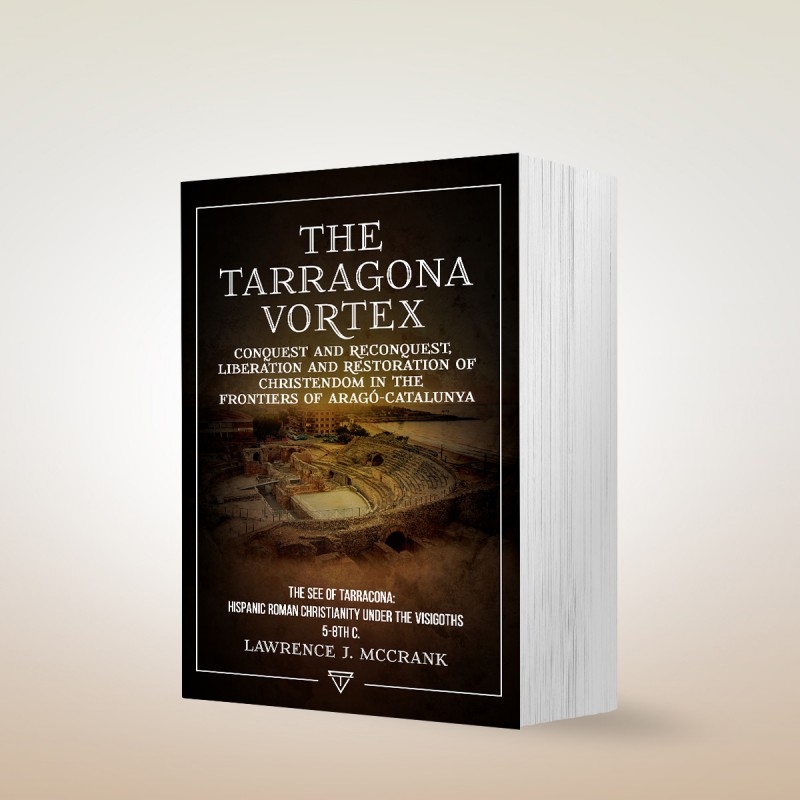
Roman Tarraco morphed into Tarracona with the Visigothic successor state starting with the reign of Euric. It lay just outside the Visigoths' second kingdom after the Battle of Vogle in 506 when they were driven by the Franks out of Tolosa, with new dual capitals of Narbona and Barcinona, and the move of many tribesmen into the peninsula resulted in three resettlement areas: Old Gotica in the Narbonensis remained; there were midland settlements from Tarracona over to Caesaraugustanam; and the hegemonic Kingdom of Toletumn. Most histories concentrate on the latter, but this study focuses on northeastern Spain and hence on the middle kingdom and its relations with both sides, Rather than the secular history of the era, the subject is the Tarraconensian Church after the introduction of Christianity to the peninsula, from the Pauline and Jacobean missions in the 1st c. to the formal establishment of the bishopric of Tarraco by the early 3rd c., with continued ties to the Roman Church as exemplified by correspondence and the legendary Holy Grail transfer. The history of early Christianity is examined after the era of Persecutions into the Patristic period. Then the main story is the tension between the Visigothic Arian Church and Roman Catholicism in the making, and the changes at Tarracona itself. The episcopal succession at Tarracona is delineated through the end of schism in 589, evidence of the organization and foundation of a State-Church in the Councils of Toletum, and the geo-ecclesiology of the Hispanic Church, its bishoprics and metropolitanates, and especially the Greco influence in Church leadership and two 6th c. outstanding archbishops at Tarracona. Finally, the diversion between the regular and secular Church is examined with the late-antique monastic movement and several seminal houses in the province, the adoption of the Benedictine Rule, and the impact of asceticism represented by the female-supported cult of St. Thecla at Tarracona, competing with the indigenous official martyrial cult of St. Fructuosus. The status of the Church through trials and tribulations reveals the sporadic success of Christianization as an urban phenomenon without full coverage of the countryside, so that it was vulnerable to being eclipsed by Islam when the Muslim Conquest resulted in the collapse of the Visigothic state.
This multi-volume lifelong work features a millennium of history in a major frontier for the Romans, Visigoths, Muslims, and Latin Christians in North-East Iberia and Southern France from Late-Antiquity through the Middle Ages, i.e., the 3rd to 13th c., that defined the political geography of the West – Southern Europe, the Western Mediterranean, and Spain. Focusing on Tarragona and its province of the Tarraconensis that became the Crown of Aragó-Catalunya, separate volumes in the series, each entitled as an individual book, treat (1) Historiography, key constructs, and reconsiderations about Religion; (2) foundational Roman Tarraco; (3) Hispano-Visigothic Tarracona; (4) Berber Tarrakūnah where the expansion of African Islām was stopped; (5) Terrachona and the restoration of Christendom; and (6) Tarragona as an epilogue, critical apparatus, and an extensive bibliography.
LAWRENCE J. MCCRANK, BA, MA, MLS, PhD.
Professor and Dean Emeritus
Now retired after a 40-year career as a professor and dean / university librarian, your author has written 18 books, bibliographies, and 70 scholarly articles, and thus has been recognized in bibliometric studies as one of America’s most published academic librarians. His contributions are in two fields: (1) the Information Sciences and Library / Archives profession for Heritage studies (especially in Archives, Documentation, Curatorship and Library Special Collections, Codicology and Analytical Bibliography) and academic library administration, with a pioneering interest in computer applications from informatics to modern information systems (including one of the first books totally electronically published before widespread digitization); and (2) Medieval and Early Modern History (History of Archives, Libraries, Codicology and Analytical Bibliography, monastic history especially the Cistercians; Church History; and History of the American West). He is a Fellow of SAA (Society of American Archivists) and RSAT (Reial Societat Arqueológico Tarraconensis). After a start at the University of Kansas under a team of outstanding medievalists and as a student of the late Hispanist and AHA bibliographer, Spain’s knighted Charles J. Bishko, at the University of Virginia where he earned his PhD (1974), he focused on Tarragona as an emblematic city and northeastern Spain’s federated Catalan and Aragonese regions and Occitania in southern France.


Publication date: December, 2025
Pages: 1035
ISBN 978-615-6405-32-6 Paperback, €93.00
ISBN 978-615-6405-49-4 Hardcover, €152.00
eISBN 978-615-6405-56-2 eBook, €93.00
For any unavailable copies on our website, please refer to our distributors: ISD LLC for North and South America and Mare Nostrum for Europe and the rest of the world.


I am most pleased to recommend Trivent publishing to anyone who is at the “publish a book” stage of life. The team is professional, outstanding, supportive, they are intelligent editors who will direct, not coddle, an author on his/her journey to publication.

I have been working with the Philosophical Journal of Conflict and Violence since its debut in 2017. It has been a pleasant experience to see how the papers take shape in the process from submission to peer review to publication. The editor-in-chief together with the Trivent team do a tremendous job and are always seeking quality above all!

I’ve participated in two conferences organized by Trivent in the last few years and both were a nice experience – went smoothly and had decent talks in good spirit. When it came to managing manuscripts, I was surprised by the professionalism by which they helped my text get published. I definitely enjoyed working with them!
 Download PDF