


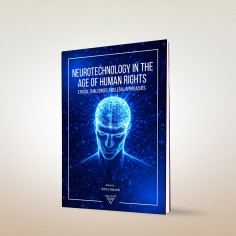
Publication date: March, 2026
Pages: 329
ISBN 978-615-7058-09-5 Paperback, €54
ISBN 978-615-7058-08-8 Hardcover, €89
eISBN 978-615-7058-10-1 eBook, €54
For any unavailable copies on our website, please refer to our distributors: ISD LLC for North and South America and Mare Nostrum for Europe and the rest of the world.
 Selected chapters are available in open access
Introduction by Silvia Salardi  Download PDF
Neurotechnology and Ethics of Human Rights. Some Considerations
Peter G. Kirchschläger
Self-Determination and the Availability of the Neurocognitive Self: De Iure Condendo Perspectives Between Body, Brain and Neuro-Rights
Beatrice Picollo
Screening the Silent: Ethical Dilemmas of Predictive Amyloid Pet in Japan
Tamami Fukushi, Hitoshi Shimada, Nobuyuki Shirakawa
Neurotechnology and Disability: Mapping Concepts, Ethical Dilemmas, and Legal Frameworks
Carlos Granados Domínguez
The (Non-)Replicability of Consciousness: Ethical and Scientific Challenges in the Age of Artificial Intelligence
Giordana Truscelli
Sovereignty Begins in the Mind: Ethical Governance for Protecting Cognitive Liberty
Rachael L. McIntosh
Upcycling Rights and Tailoring Laws to Neurotechnologies
Giulia Maria Servida
Neuroprivacy: From Positive Law to Challenges in Criminal Proceedings
Alessandro Manfredi, Fenice Valentina Valenti
The Neuroscientific Roots of Criminal Sanction in the Restorative Justice System
Martina Greppi
De Iure Condendo Perspectives on Neurorights: Regulation vs. Deregulation in the Age of Human Rights
Francesco Stocchi
“Cognitive Liberty” from the Perspective of Japanese Constitutional Law 231
Masatoshi Kokubo
Between Ethics and Law: Cognitive and Moral Enhancement in the Neurotechnological Era
Claudia Aniballi
Do We Need New Neuro-Rights in the Workplace? An Analysis From a European Perspective
José M. Diéguez-Rodríguez
Neurorights Applied to Neurogames
Diego Saldivar
The Right to Remain Opaque: Neuroscience, Intentionality, and the Concept of the Legal Mind
Alessia Del Pizzo
The past decade has witnessed an unprecedented increase in institutional interest in neurotechnology. Despite some types of modern neurotechnology being applied in medicine since the 1970s, its current use is no longer confined to medical applications. On the contrary, neurotechnology has expanded its applications beyond the medical field to include, among others, direct-to-consumer non-invasive neurotechnology for wellness and well-being, forensic neurotechnology, neurogaming, and neuroenhancement.
In addressing these topics and their relationship with human rights, this volume aims to survey the current state of affairs, analyse emerging trends, problems, and gesture towards future development in this field. The volume was motivated by the concern to investigate the ethical and legal questions arising from this uniquely disruptive technology in the age of human rights.
The book gathers selected contributions presented at the International Conference on Neurotechnology in the Age of Human Rights held online on September 17th, 2025, sponsored jointly by the University of Milano-Bicocca, School of Law (Italy), and Trivent Publishing.
Silvia Salardi (PhD) is Associate Professor of Philosophy of Law and Bioethics at the University of Milano-Bicocca (School of Law), where she has coordinated different Erasmus+ Projects on the technological transformation of society in collaboration with European and non-European Universities. Her research interests range from legal analytical linguistic philosophy to bioethics and biolaw. She has spent visiting periods at the Philosophisches Seminar at the Albert-Ludwig University in Freiburg (Germany), at the Institute for Biomedical Ethics at the University of Basel (Switzerland), at the Institute of Biomedical Ethics and the History of Medicine at the University of Zurich (Switzerland), and at the Institute of Social Ethics at the University of Lucerne (Switzerland).
She is the author of scientific papers, essays, and books published both at the national and international level. Her most recent books deals with AI and the semantics of change (Intelligenza artificiale e semantica del cambiamento: una lettura critica, Giappichelli, 2023) and with neurotechnological advances applied to medical and non-medical purposes (Neurotecnologie tra potere e libertà. Medicina, etica, discriminazioni di genere, Wolters Kluwer, 2024).
The rapid progress of neurosciences in recent decades has allowed us not only to learn in detail about the brain functions associated with our basic mental abilities, but also to design interventions in these functions. The fields of shaping and expressing human will are no longer unexplored territory in science, thanks to the development of advanced technology, the limits of which are constantly expanding. This development could not leave ethics and law indifferent, as it directly concerns the core of our self-determination. Fundamental rights such as the right to personality, freedom of will, freedom of expression, the right to health, but also privacy are directly affected, and the regulatory adequacy of their traditional protection is already being re-examined. Neuroethics and neurolaw are now new fields experiencing exceptional growth worldwide, corresponding to the applications of neuroscience.
In this volume, the development of neuroethics and neurolaw is presented in its most important dimensions. The contributions of distinguished and young scholars cover a wide range of interests, focusing on the concept of self-determination and questions that arise in different contexts, from the situation of vulnerable persons, the relationship between neurotechnology and artificial intelligence, interventions to enhance natural mental abilities, neurotechnology’s impact on the development of criminology and criminal law, to its applications in the workplace or in games. The authors discuss at length the major problem of recognizing a new category of rights aimed at protecting our privacy and cognitive freedom from unlawful interference by this technology.
The overall contribution of this volume is that it broadens the scope of normative sciences by raising new questions for investigation. A classic mistake that we often encounter in ethical and legal discussions of new areas of interest arising from technology is the formulation of "ready-made" solutions that usually result from analyses attached to the past, before the experience of the new reality has emerged. Such ready-made solutions are usually fearful of this reality, offering only apparent certainty about "what we do." What they fail to realize is that in this way, they risk remaining inapplicable, losing the necessary communication with technology and those who serve it. The studies in this volume avoid this mistake, recognizing the need for an interdisciplinary approach to their subject matter, that is, an ongoing dialogue between ethics and law with neurosciences and neurotechnology. They thus pose valid questions, opening up fields of reflection and approaching the prospect of real solutions.
Takis Vidalis, International Hellenic University, BioMedLex


Publication date: March, 2026
Pages: 329
ISBN 978-615-7058-09-5 Paperback, €54
ISBN 978-615-7058-08-8 Hardcover, €89
eISBN 978-615-7058-10-1 eBook, €54
For any unavailable copies on our website, please refer to our distributors: ISD LLC for North and South America and Mare Nostrum for Europe and the rest of the world.
Selected chapters are available in open access


I am most pleased to recommend Trivent publishing to anyone who is at the “publish a book” stage of life. The team is professional, outstanding, supportive, they are intelligent editors who will direct, not coddle, an author on his/her journey to publication.

I have been working with the Philosophical Journal of Conflict and Violence since its debut in 2017. It has been a pleasant experience to see how the papers take shape in the process from submission to peer review to publication. The editor-in-chief together with the Trivent team do a tremendous job and are always seeking quality above all!

I’ve participated in two conferences organized by Trivent in the last few years and both were a nice experience – went smoothly and had decent talks in good spirit. When it came to managing manuscripts, I was surprised by the professionalism by which they helped my text get published. I definitely enjoyed working with them!