

- New


Publication date: September, 2026
10.22618/TP.BRHTEM.2026.361
ISBN 978-615-7058-35-4 Paperback, €55
ISBN 978-615-7058-34-7 Hardcover, €79
eISBN 978-615-7058-36-1 eBook, €55
For any unavailable copies on our website, please refer to our distributors: ISD LLC for North and South America and Mare Nostrum for Europe and the rest of the world.
 Selected chapters available in open access
Introduction: What Do We Talk about When We Talk About Historical Breeds?  Download PDF
Anastasija Ropa
Did Horse “Breeds” Exist in the Middle Ages?
Clothilde Noé
Icelandic Horses: An Overview of Origins and Roles
Samantha Cone
Additional Examples of the Uses of Horses in the Byzantine World from the Histories by John Kantakouzenos
Alexia-Foteini Stamouli
Portuguese Equids in the Medieval World from the Tenth to the Thirteenth Centuries
Afonso Soares De Sousa
Defining the English “Hackney:” Type and Terminology Download PDF
John Clark
Horses for Courses: Galloways at the Races
Miriam A. Bibby
The Missing Warhorse, or the End of an Era?
Kelly-Anne Gilbertson
Wild Horses from the West to the East of Medieval Europe
Anastasija Ropa
The Râvît: A Middle High German Term for the “Saracen” Warhorse?
Jürg Gassmann
The Liminal Mule: Equine Ambivalence in Spenser and the Literary Emblem
Kristen L. Olson
Notes on Contributors
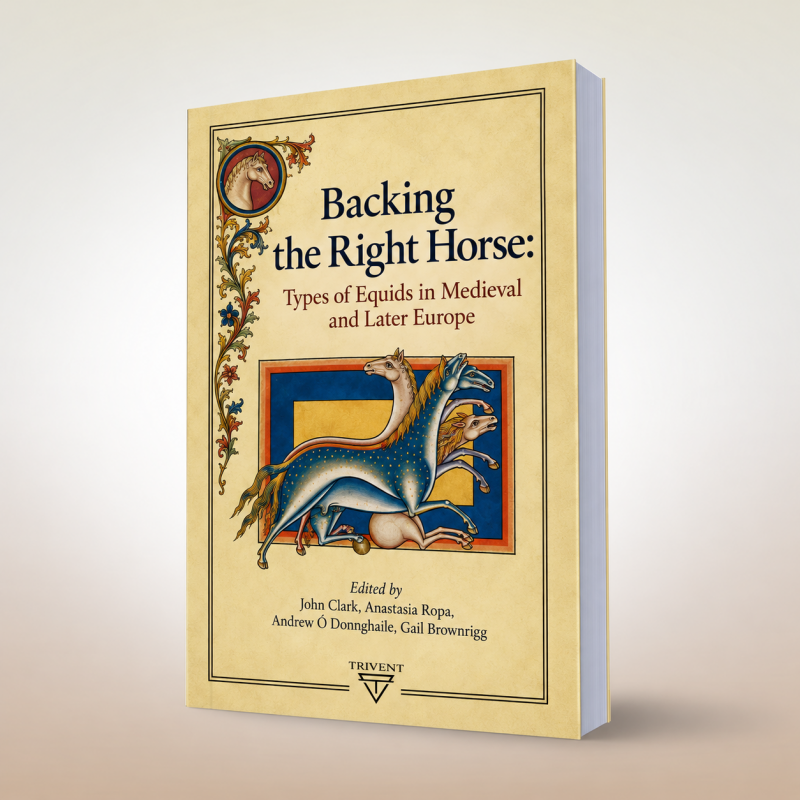
Destriers, rounceys, palfreys, hackneys, Friesians, Arabians, Galloways... Nowadays, we identify horses primarily by their breed, but, historically, horses were more often known by their function, and if imported, by origin. Breeds as we define them today come into existence relatively late. The studies in this volume explain the mysterious combinations of type, employment and geography as the most common way of identifying horses and other equids, which often confuse historians and lay readers alike.
John Clark was for many years curator of the medieval collections of the Museum of London (now London Museum), during which time he published The Medieval Horse and its Equipment, a study of medieval finds from London excavations. Since his retirement in 2009 he has continued his interest in medieval horses and horse equipment and has contributed on the subject to publications and conferences. A Festschrift in his honour The Horse in History was published in 2025.
Anastasija Ropa, PhD, is editor of Cheiron: The International Journal of Equine and Equestrian History. Her publications in horse history include the academic monograph Practical Horsemanship in Medieval Arthurian Romance (2019), and, recently, a book for general audience, The Medieval Horse (2025).
Andrew Ó Donnghaile is a postdoctoral researcher at University College Dublin. His research interests include early Irish law, medieval insular political, military, and equestrian history, and Eurasian military history. His work on medieval Irish saddles, equitation, and use of cavalry are informed by a reconstructive practical approach, the results of which are in forthcoming publications. He also practices and teaches Eurasian equestrian martial arts.
Gail Brownrigg is independent scholar with a special interest in the history of the harness and has presented work in this area at numerous conferences, including the conference of the European Association of Archaeologists. Her published work focuses on pre-modern horse harness, including a co-edited volume in the BAR International Series, Chariots in Antiquity: Essays in Honour of Joost Crouwel, edited by Peter Raulwing, Stefan Burmeister, Gail Brownrigg, and Katheryn M. Linduff (2023).



Publication date: September, 2026
10.22618/TP.BRHTEM.2026.361
ISBN 978-615-7058-35-4 Paperback, €55
ISBN 978-615-7058-34-7 Hardcover, €79
eISBN 978-615-7058-36-1 eBook, €55
For any unavailable copies on our website, please refer to our distributors: ISD LLC for North and South America and Mare Nostrum for Europe and the rest of the world.
Selected chapters available in open access


I am most pleased to recommend Trivent publishing to anyone who is at the “publish a book” stage of life. The team is professional, outstanding, supportive, they are intelligent editors who will direct, not coddle, an author on his/her journey to publication.

I have been working with the Philosophical Journal of Conflict and Violence since its debut in 2017. It has been a pleasant experience to see how the papers take shape in the process from submission to peer review to publication. The editor-in-chief together with the Trivent team do a tremendous job and are always seeking quality above all!

I’ve participated in two conferences organized by Trivent in the last few years and both were a nice experience – went smoothly and had decent talks in good spirit. When it came to managing manuscripts, I was surprised by the professionalism by which they helped my text get published. I definitely enjoyed working with them!